Our schedule is filling up quickly. Call 651-329-4815 today for availability and to book your window replacement in Maplewood, MN.
We thoroughly protect the window opening from the outside. Then, using high-quality materials, we can replace windows on most days during a MN winter. No need to delay a serious window issue until spring.
What Makes a Window Perform Well When Minnesota Temperatures Plunge?
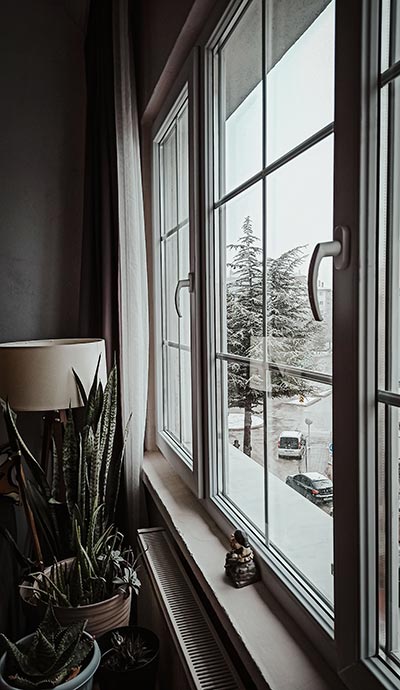
On a bitter Minnesota winter morning, the difference between an average window and a high-performance window is much easier to appreciate.
A window isn’t simply a piece of glass separating your living room from the outdoors. It’s a system of glass, coatings, insulating spaces, spacers, frames, weather seals, and hardware—all of which must work together while one side of the window is exposed to freezing temperatures and the other faces a warm home.
For homeowners in Maplewood, MN, understanding window components can make shopping for replacement windows much easier.
Terms such as Low-E, U-factor, argon, triple-pane, and warm-edge spacer may sound technical, but each describes something that affects how your windows perform. Once you understand what these features actually do, you can make an informed decision about which ones matter for your home.
U-Factor Helps You Compare Winter Performance
One of the most useful ratings for Maplewood homeowners is U-factor. U-factor measures the rate of heat transfer through a window assembly. A lower U-factor means the window provides greater resistance to heat flow. That’s particularly relevant in January, when your heated home may be dramatically warmer than the outdoors.
A lower U-factor doesn’t mean you’ll never feel temperature differences near glass, nor does it mean one number should determine your entire purchase. But it helps provide a standardized way to compare thermal performance among window configurations.
When evaluating products, ask about the U-factor of the specific configuration you’re considering rather than assuming every window from a particular manufacturer performs identically.
Multiple Panes Create Insulating Spaces
A single sheet of glass provides relatively little insulation. Modern windows improve performance by creating sealed insulating spaces between multiple panes.
Double-pane windows contain one insulating space, while triple-pane windows contain two. Those cavities may be filled with an insulating gas such as argon. Argon is denser than ordinary air and helps slow heat transfer through the insulated glass unit. Some specialized configurations may use other gases, but the important concept is simple: the space between the panes isn’t empty space. It’s part of the window’s insulation system.
Triple-pane glass can provide excellent thermal performance and may offer meaningful sound-reduction benefits. However, the number of panes still doesn’t determine performance by itself.
Don’t Assume Triple Pane Is Always the Only Answer
Minnesota’s cold climate makes triple-pane glass a plausible option, but modern specialty double-pane systems can also achieve impressive performance. For example, Andersen’s Low-E4 PassiveSun® with HeatLock® double-pane configuration can achieve a U-factor as low as .23, depending on the particular window configuration. This illustrates an important point: compare performance, not just pane count.
A sophisticated double-pane window with advanced coatings may be a better fit for one project, while triple-pane glass may provide advantages for another—particularly when sound reduction is a major concern.
The goal isn’t to buy the greatest number of panes. It’s to choose a window system that delivers the performance you need.
Spacers Matter More Than Most Homeowners Realize
Look closely at a double- or triple-pane window, and you’ll see a spacer around the perimeter separating the panes. It may seem like a small component, but it performs several important jobs. The spacer helps maintain the proper distance between panes and helps preserve the sealed insulating glass unit. Because the perimeter of the glass can be a pathway for heat transfer, warm-edge spacer technologies are designed to reduce thermal conduction compared with highly conductive traditional spacer materials.
Maplewood homeowners don’t necessarily need to become experts in spacer construction, but it’s worth recognizing that high-performance glass involves more than what’s happening in the center of the pane.
The edges matter too.
Air Leakage Undermines Good Insulation
Thermal insulation is only half of the Maplewood window winter-comfort equation. A window may have excellent glass, but if cold air moves through gaps around the sash or frame, the room can still feel uncomfortable. Quality weatherstripping helps seal operating portions of the window. Hardware and locks help hold those components securely together when the window is closed. Then there’s another potential source of air leakage: the area between the window frame and the house.
Specialty Glass Can Address Other Comfort Problems
Keeping your Maplewood home warm may be the priority in January, but high-performance glass can solve other problems throughout the year.
Our featured vinyl manufacturer, ProVia, offers 15 glass configurations, which allow homeowners to choose packages based on different priorities.
Depending on the product and configuration, specialty glazing can help address:
- Winter insulation and overall energy performance
- Summer solar heat
- Outside noise
- UV exposure and fading
- Passive solar performance
This allows a homeowner to think beyond a generic “energy-efficient window” and choose features based on how each room actually behaves.
A bedroom near traffic may need different glass from a sunny family room overlooking the backyard.
Warmth Comes from the Whole Window
If there’s one takeaway for homeowners shopping for windows this winter, it’s this: don’t judge a window by one feature.
High-performance windows combine multiple technologies. Insulated glass slows heat transfer. Low-E coatings manage radiant energy. Gas fills improve the insulating space. Spacers contribute to edge-of-glass performance. Frames, weatherstripping, and hardware complete the unit.
Professional installation then integrates that window with your home.
When those pieces work together, the result is more than a specification on a label. It’s a home that can feel more comfortable when Minnesota temperatures are at their coldest.
Choose A Pane in the Glass Construction for Your Window Project
At A Pane in the Glass Construction, we help Maplewood homeowners understand window performance without inundating them with technical terminology.
We’ll listen to the problems you’re experiencing and help you choose products from manufacturers such as Andersen and ProVia. We’ll explain the differences between glass packages, double- and triple-pane options, Low-E coatings, frame materials, and other features so you can decide where your investment will make the greatest difference.
Our experienced team then provides professional installation designed to help your chosen windows perform as a complete system.